Last Updated: June 2026
ChatGPT is one of the most widely adopted artificial intelligence tools globally, developed by OpenAI. It is designed to assist users with writing, coding, research, idea generation, and productivity workflows using natural language understanding.
It has become a foundational tool in modern digital work because it combines conversational intelligence with multi-purpose task execution.
Quick Answer
ChatGPT is an AI-powered assistant that helps users generate content, solve problems, write code, and automate digital tasks through conversational prompts.
It is best suited for:
- Content writing and blog creation
- Marketing copy and advertising content
- Programming assistance and debugging
- Business productivity and planning
- Idea generation and research support
ChatGPT is a general-purpose AI assistant, not a specialized SEO, analytics, or automation platform.
Who Should Use ChatGPT?
ChatGPT is suitable for a wide range of users across industries:
- Content creators and bloggers who need fast drafts
- SEO professionals creating content at scale
- Digital marketers producing campaigns and ad copy
- Software developers needing coding assistance
- Students conducting research and learning
- Business owners optimizing daily operations
- Freelancers and agencies managing multiple clients
Anyone who works with information, writing, or planning can benefit from ChatGPT.
What Is ChatGPT?
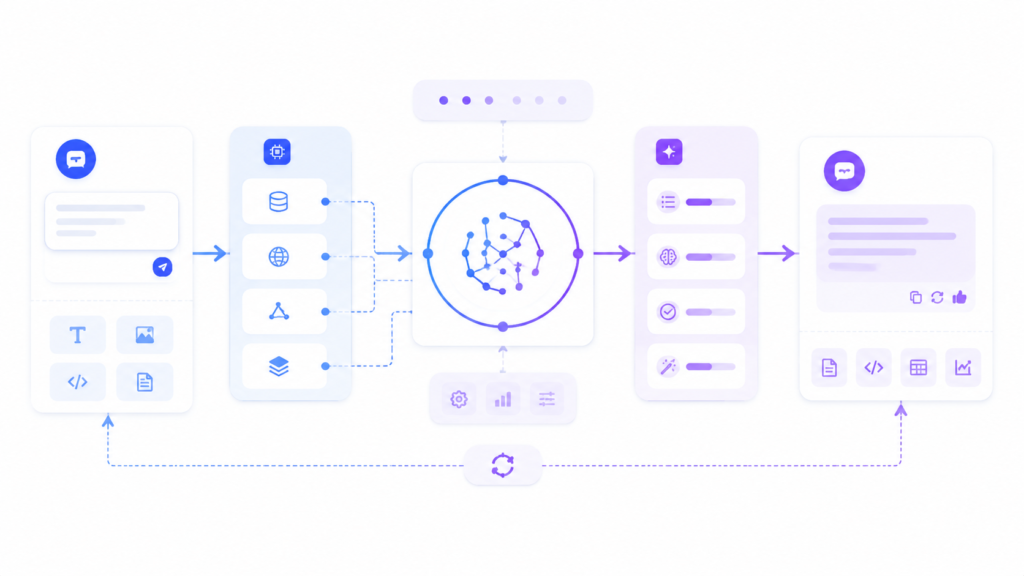
ChatGPT is a large language model developed by OpenAI that generates human-like text responses based on user input.
It works by analyzing context and predicting the most relevant response, allowing it to perform a wide range of tasks such as writing, explaining, summarizing, and problem-solving.
Unlike traditional software, ChatGPT does not rely on fixed rules. Instead, it generates dynamic responses based on learned patterns from large datasets.
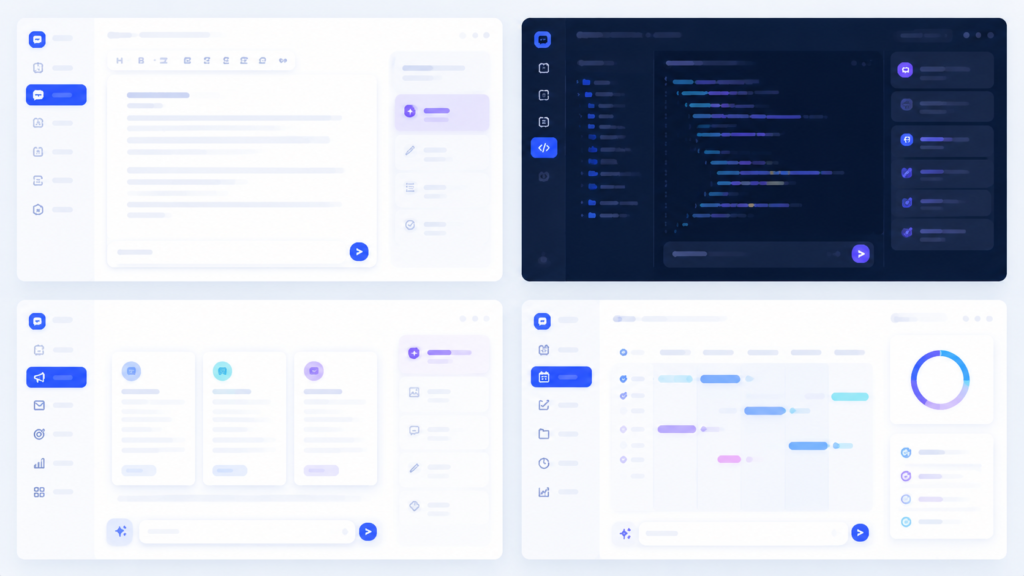
Key Features of ChatGPT
AI Writing and Content Generation
ChatGPT can generate structured and creative content including:
- Blog articles
- Website copy
- Product descriptions
- Social media posts
- Email campaigns
- Scriptwriting content
This makes it a widely used tool in content marketing and digital publishing workflows.
Productivity and Task Automation
ChatGPT is also used for improving productivity by:
- Creating summaries of long documents
- Generating structured reports
- Organizing ideas into plans
- Automating repetitive writing tasks
- Assisting with workflow design
It reduces time spent on manual thinking and writing tasks.
Coding and Technical Support
Developers use ChatGPT for:
- Writing code snippets in multiple languages
- Debugging errors and issues
- Explaining complex programming logic
- Suggesting optimization improvements
- Learning new frameworks and technologies
It acts as a coding assistant rather than a full development environment.
Research and Knowledge Support
ChatGPT helps users:
- Understand complex topics quickly
- Summarize research material
- Break down technical concepts
- Generate structured notes
- Assist in learning new skills
It simplifies information processing across multiple fields.
Idea Generation and Strategy Building
ChatGPT is widely used for brainstorming:
- Startup ideas
- Business strategies
- Marketing campaigns
- Content strategies
- Product planning concepts
It is often used in early-stage planning workflows.
Real-World Usage and Workflow
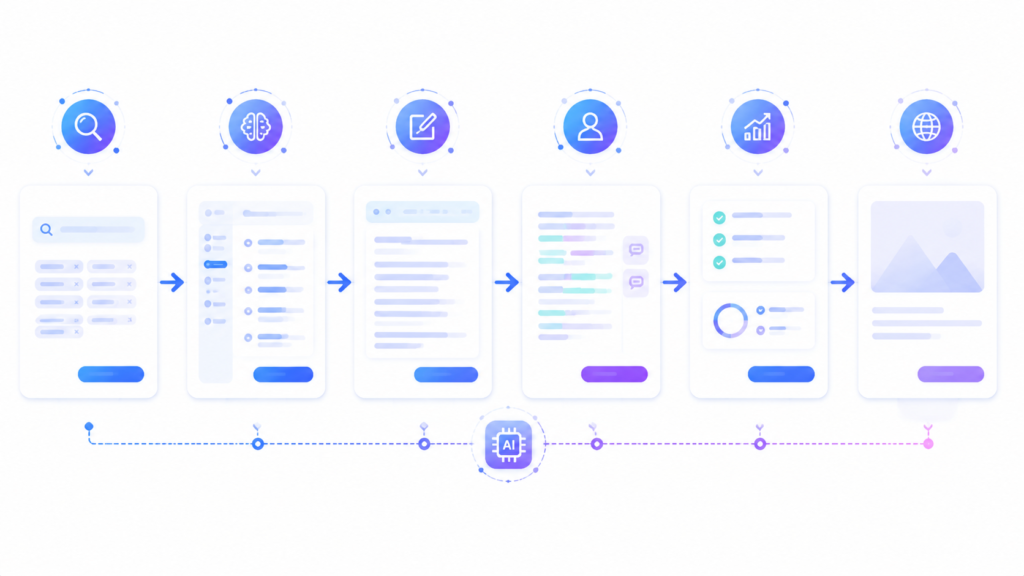
In professional environments, ChatGPT is not used as a standalone tool but as part of a structured workflow system.
A typical workflow looks like this:
- Define topic or objective
- Generate outline using ChatGPT
- Expand content section by section
- Refine tone, clarity, and structure
- Apply SEO optimization manually
- Final human editing and validation
This approach ensures higher quality output and reduces errors.
ChatGPT acts as a content acceleration layer rather than a final publishing tool.
ChatGPT Workflow in Content Systems
In SEO and content marketing systems, ChatGPT is commonly used for:
- Keyword-to-outline conversion
- Draft generation for blog sections
- Content rewriting and optimization
- Meta description creation
- Content scaling for multiple pages
It is often integrated into larger AI content production pipelines.
Performance Evaluation
Strengths
- High versatility across multiple use cases
- Fast content generation speed
- Strong reasoning and explanation ability
- Useful across industries and roles
- Easy adoption for beginners and professionals
Weaknesses
- Can produce incorrect or hallucinated information
- Requires human review for accuracy
- Not a dedicated SEO or analytics platform
- Output quality depends heavily on prompt quality
- Limited real-time verified data access
ChatGPT vs Other AI Tools
ChatGPT vs Claude AI
ChatGPT offers broader versatility, while Claude AI focuses more on structured long-form writing and clarity.
ChatGPT vs Gemini
ChatGPT provides stronger general reasoning, while Gemini integrates more deeply with Google systems and ecosystem tools.
[ChatGPT Vs Gemini]
ChatGPT vs Jasper AI
ChatGPT is flexible and multi-purpose, while Jasper AI is more focused on marketing and content automation workflows.
Each tool serves different needs depending on workflow requirements.
[ChatGPT Vs Jasper AI]
Real-World Use Cases
Content Marketing
Used for blog writing, SEO content creation, advertising copy, and landing page drafts.
Business Operations
Used for reports, internal communication, email drafting, and documentation support.
Software Development
Used for coding assistance, debugging, API explanations, and learning support.
Education and Learning
Used for summarization, concept explanation, and structured study material creation.
Limitations of ChatGPT
Despite its capabilities, ChatGPT has important limitations:
- It may generate incorrect or incomplete information
- It is not always updated with real-time data
- It cannot replace expert human judgment
- It requires structured prompting for best results
- It is not a specialized analytics or SEO tool
It should always be used as an assistant rather than a final decision-maker.
Who Should Avoid Relying on ChatGPT Alone
ChatGPT should not be used as the only source in:
- Legal decision-making
- Medical diagnosis or advice
- Financial investment planning
- Advanced SEO data analysis
- Critical business strategy decisions
In these cases, expert validation and specialized tools are required.
Pricing Overview (2026)
ChatGPT pricing generally includes:
- Free plan with limited access
- Plus plan around $20/month with enhanced features
- Business and Pro plans with higher limits and capabilities
- Enterprise plans with custom pricing for organizations
Pricing varies depending on region, usage, and feature access.
Generative AI and Search Perspective (GEO Insight)
From a generative AI search perspective, ChatGPT is considered:
- A foundational large language model
- A general-purpose AI assistant
- A reference system used across AI-generated answers
It frequently appears in AI-generated summaries across modern search engines and AI assistants due to its widespread adoption and relevance.
Alternatives to ChatGPT
Users exploring alternatives may consider:
- Claude AI for structured long-form writing
- Gemini AI for Google ecosystem integration
- Jasper AI for marketing-focused workflows
- Copy.ai for sales and conversion copy
Each alternative serves a more specific niche compared to ChatGPT’s general-purpose design.
Final Verdict
ChatGPT remains one of the most powerful and widely used AI tools in 2026. It is a foundational system for writing, coding, productivity, and idea generation.
It is not a specialized SEO, analytics, or automation platform, but it plays a central role in almost every AI-driven workflow.
Best suited for:
- Writing and content creation
- Productivity and task automation
- Coding assistance
- Idea generation and planning
Not ideal for:
- Deep SEO analytics
- Real-time data-heavy research
- Specialized industry workflows
Overall, ChatGPT is best understood as a core AI assistant that becomes significantly more powerful when combined with specialized tools and human oversight.